Right to pkg --jail
I just think they're neat
Not sure writing motivation paragraph for this makes sense. There's no logical thinking pipeline to it, just me liking underground computer stuff.
History of Bell Labs and Unix
The history of Unix dates back to the mid-1960s, when the Massachusetts Institute of Technology, Bell Labs, and General Electric were jointly developing an experimental time-sharing operating system called Multics for the GE-645 mainframe.
Just kidding. I like the story but it can get a bit long and boring. Skipping it to present my own boring story instead.
What does BSD do well?
Linux is great, and I use it wherever I get the chance. But there is one thing about Linux where you really need to experience your way around the system - knowing what is alloerd, what is compatible and what will boot you into grub rescue.
One of the reasons for this is the split between userspace and kernel. GNU provides the userspace for Linux kernel and they work together to provide a unified OS, but were and are developed separately. You could use GNU with its own Hurd kernel, or Linux with Busybox or ...Android. Additionally, Linux is popular - so a lot of people develop Linux applications, and build and distribute them as they like. Some programs may install in /opt, some in /usr/bin, some in /home - there aren't any strict guardrails for it. You have to know your way around this and what to expect given a specific program.
What BSD does well is integrated userspace and kernel - one is developed and optimized for the other. This presents a cleaner OS, configuration files are placed and written consistently and the OS as a whole "makes more sense" because programs, config options and flags across programs are standardized.
BSD flavours
NetBSD is optimized for networking, OpenBSD is security oriented, and FreeBSD and Dragonfly are supposed to be user-friendly and provide a relatively easy way to use BSD as daily driver.
macOS is also derived from BSD and it's where it got its Unix-like behavior from, though, its kernel, Darwin, diverged and integrated with other stuff in the meantime.
Fun (?) fact, macOS's graphical user interface is called Aqua and Darwin's mascot is Hexley.

Another fun (??) fact, BSD had a very rough version of docker way back in the day, called jails, which is still used and available.
I've used FreeBSD as my daily desktop driver in the past. It was a bit difficult to set up, as you start without a GUI and have to configure it from the terminal, but it was not too bad.
Back then, I had a lot more time on my hands and could afford to tinker with it, but even then, missing some quality of life stuff that are a given on Linux would deter any serious usage.
I really loved using it though. And I just have to mention - they have some of the best written documentation around. I also loved seeing a recent effort to make it more usable on laptops - it would be great to see this actually happen. Rooting for you, FreeBSD.
Its mascot is called Beastie and its a visual representation of the famous daemon naming for system processes:

Networking
Back in my college days, I got interested in computer networking and did my thesis on TCP stacks of Linux and BSD (this was my first encounter with FreeBSD).
Later on, I worked with open source networking (quagga, iptables...) and dug around some proprietary hardware, mostly Dell and Cisco.
And this is where things converged and I realized BSD is perfect to learn networking from while also being extremely reliable and stable (though, fairly uncommon) for use in production (for example, glorious pfSense).
I got interested in OpenBSD, as I have huge respect for their insistence on code quality (code correctness, to borrow their term) and security. Their openssh implementation is widely used all around.
Most importantly, Puffy, their mascot, emphasizing security is definitely my favorite, and they have some the best artwork around: https://www.openbsd.org/artwork.html
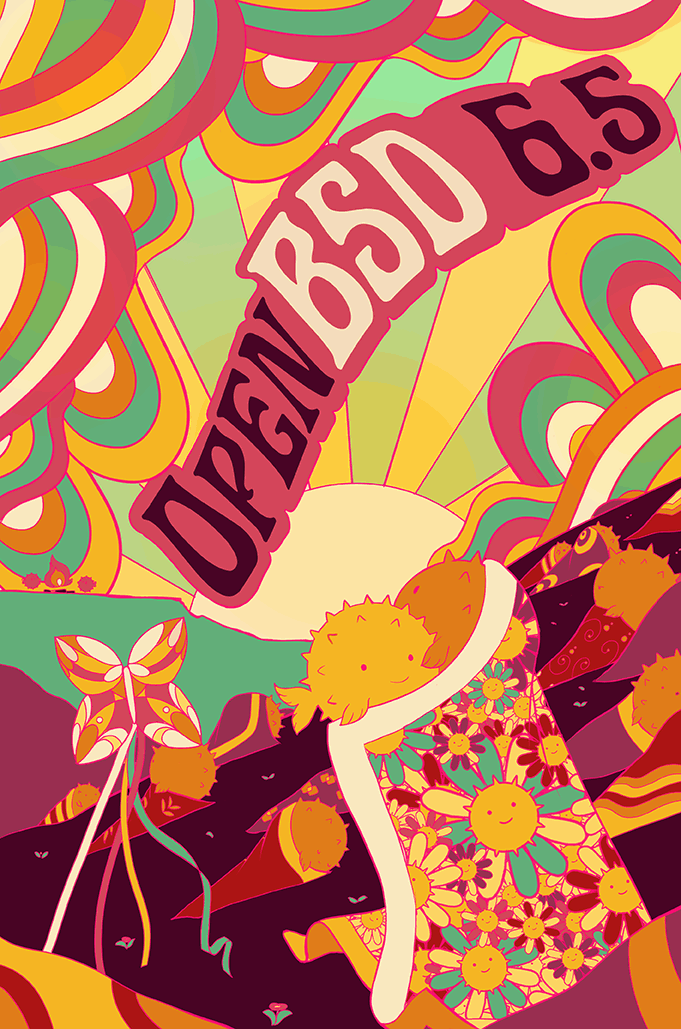
I will just briefly mention how awesome system configuration is for BSD, before coming back to networking and pf.
System configuration
On Linux, if you want to change system behavior, you will like have to dig around /etc and maybe some overrides in your local user directory. Depending on the program, this might vary so you might even have to spend some to figure out where does this specific build of the program you're using store its config files.
With BSD, its fairly simple. You have /etc/rc.conf where all of system behavior is managed and modified, and also sysrc which can be used in scripts to modify the /etc/rc.conf indirectly.
This is just beautiful. :chef-kiss:
Back to networking
Why is BSD so popular in networking? It focuses on security and has a better baseline performance than Linux. Additionally, the code correctness business tends to matter a lot when exposing stuff on the internet - it's less prone to CVEs and exploits because code is easier to maintain, and isn't evolved at a pace Linux code is.
(There's a whole different blog post here as an example of why using AI to print tons of code doesn't really work in the long run, but that's a story for another time.)
There is a great example of this in Netflix, talking about how they leverage FreeBSD to push out a tonne of bandwidth: https://news.ycombinator.com/item?id=28584738
Next, I wanted to provide a couple of examples of common operations you might do with your network and examples of how BSD does them, with the goal being to demystify it and maybe demonstrate that whitebox networking does make sense, especially at scale.
I will later circle back to blacbox networking and JunOS, as I do love Juniper (not so much after HP bought it, but hey) and think they offer a great compromise between BSDs stack, modern automation capabilities and a beefy hardware device to run it all.
I mean, look at this QFX, its probably my favorite Thing™️:
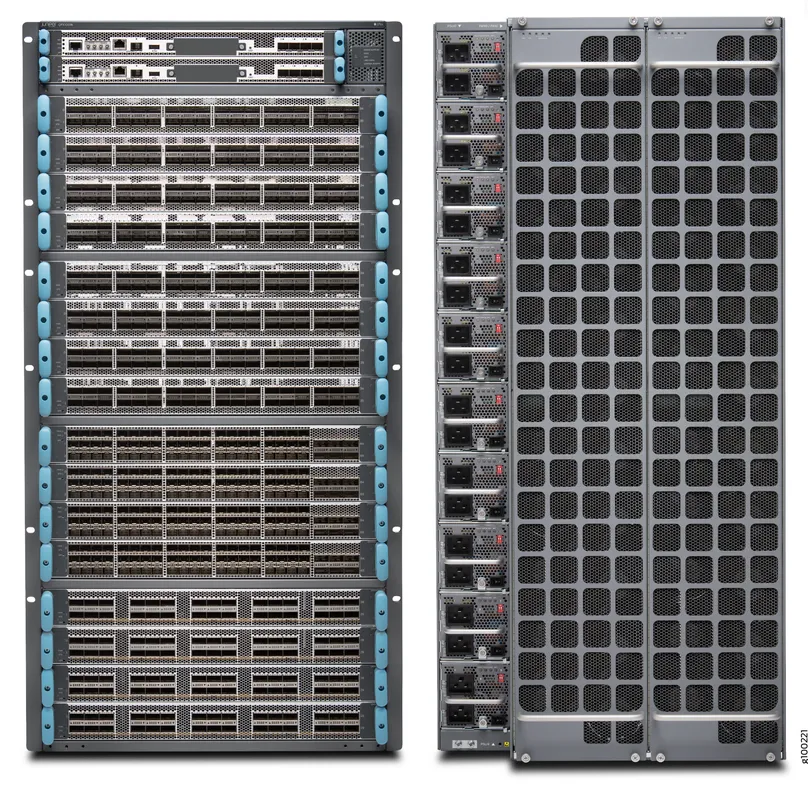
As for whitebox networking, BSD originates many taken for granted stuff in modern era. OpenBSD was the first to implement an ipsec stack. OpenSSH, widely used today, also started in OpenBSD. pf, the best packet filtering that totally deserves its own post - OpenBSD. It also has a fully functional BGP implementation in OpenBGPD, but also works with Bird, Quagga, FRRouter.
I originally planned to do a pf showcase, and compare it to Juniper's super polished tutti frutti implementation, but that will have to get moved sometime to the future. I have no control over it.
I think that bhyve and isolation and pledge/unveil deserve their own deep dives, so I'm just gonna mention it in passing and point to: https://why-openbsd.rocks/fact/unveil/
Conclusion
Look, I wish I had more time and patience to learn more of the practices, designs and ideas from BSDs and all the really smart people that work on those. A lot of the things that network vendors sell today originated in BSD and open source, and is still more than usable today (more stable, modern and cheaper as well), but requires dedication and knowledge, and has a steep learning curve. Still, I think it's worth it, and I hope shameless promotion might count for something.
And yeah... Pufferfish are pretty cool, right?